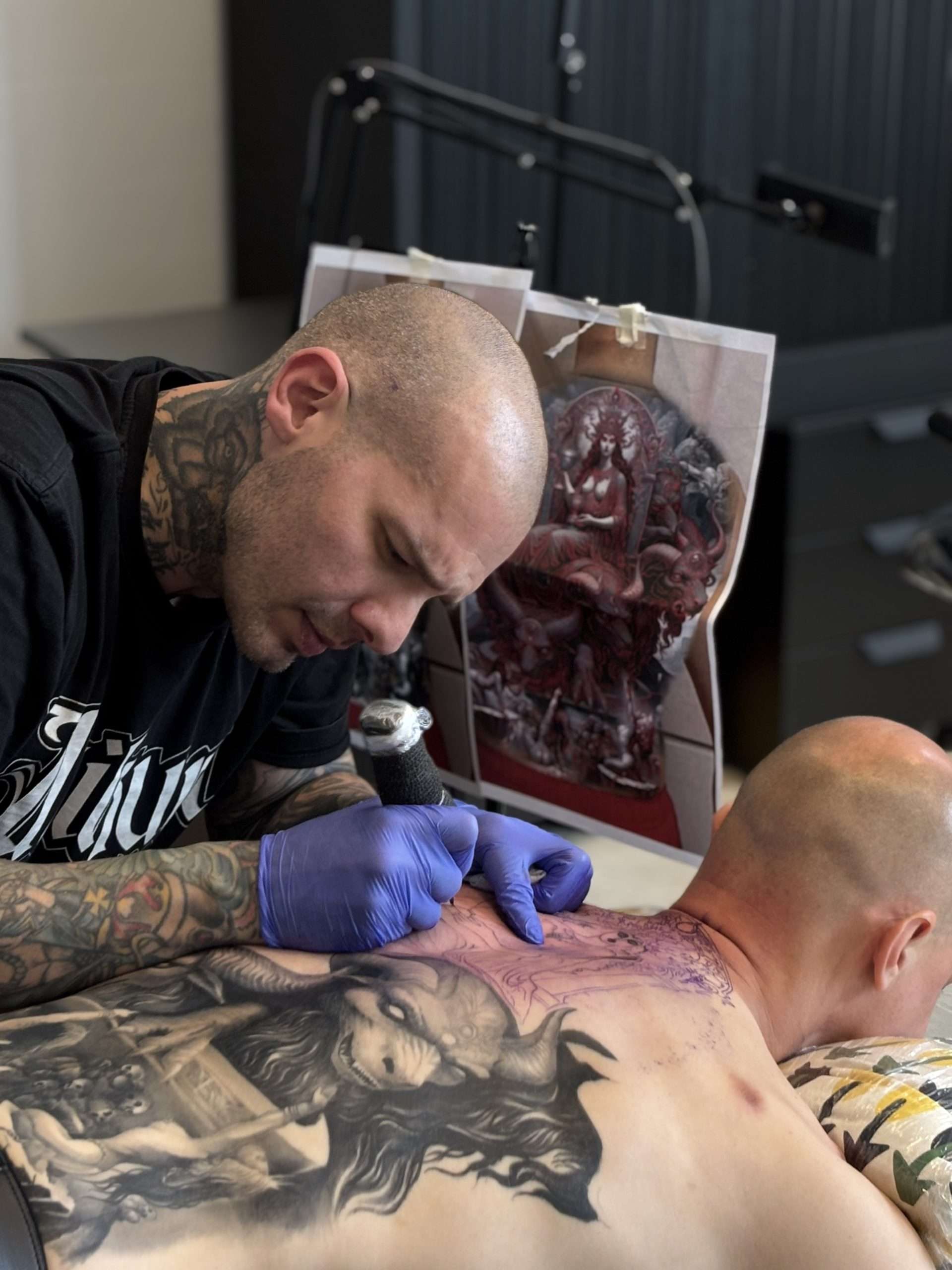
A backpiece asks more from you than a small tattoo ever will. It takes vision, patience, and trust in the artist. That is exactly why learning how to plan a tattoo backpiece matters so much – when the concept is right from the start, the finished work feels powerful, personal, and natural on the body instead of crowded or random.
The back is one of the best canvases in tattooing. It gives room for atmosphere, detail, contrast, and storytelling in a way smaller placements cannot. But that space can also create problems if the design is treated like a collage of cool ideas instead of one complete composition.
How to plan a tattoo backpiece as a full composition
The first decision is not style, shading, or even subject matter. It is whether you want one unified piece or a collection of separate images built over time. For most strong backpieces, the answer should be unity.
A backpiece works best when everything belongs to the same visual world. That does not mean every element has to match perfectly. It means the design needs a clear internal logic. If you want a raven, a forest, a warrior, and a moonlit sky, those elements should interact as one story. They should not feel like stickers placed side by side.
This is especially important in black and gray realism. Realism depends on flow, depth, and balance. A backpiece with too many disconnected focal points can lose impact fast. The eye needs a place to land first, then a path to travel through the rest of the design.
That is why many successful backpieces start with one dominant idea. It could be a central figure, an animal, a mythological scene, or a symbolic narrative. Once that anchor is clear, the surrounding elements can support it instead of competing with it.
Start with meaning, not just imagery
A lot of people begin by collecting reference photos. That makes sense, but it should not be the first step. Before you build a mood board, ask what the tattoo is actually supposed to say.
A backpiece has presence. It should carry more than surface-level aesthetics. Maybe you are drawn to Viking imagery because of heritage, strength, or mythology. Maybe horror references connect to a darker personal taste, a film influence, or a period of your life. Maybe an animal represents protection, instinct, grief, or transformation. The image matters, but the reason behind it matters more.
You do not need a dramatic life story to justify a large tattoo. But you should know what draws you to the subject. That clarity helps your artist shape a design that feels personal rather than borrowed.
The strongest custom work usually comes from a mix of direct symbolism and visual instinct. Sometimes a client knows exactly what the tattoo means. Sometimes they just know the mood they want – heavy, quiet, brutal, spiritual, dark, sacred. Both are useful. What matters is being honest about what you connect with.
Think about body flow before detail
A backpiece is not a poster. It has to work with anatomy.
The spine, shoulders, shoulder blades, and lower back all affect how a design reads. A concept that looks great on a flat screen can fall apart if it ignores those structures. This is where an experienced artist earns their place. They are not just drawing an image. They are composing for movement, muscle, and symmetry.
Some designs benefit from strong central alignment along the spine. Others work better with asymmetry, especially if the subject has motion or a more organic feel. Wings, antlers, cloaks, smoke, branches, and background textures can all help guide the eye across the back, but only if they are used with intention.
This is also where restraint matters. Many clients want to use every inch of available space with detail. Sometimes that works. Often it weakens the piece. Skin breaks, softer transitions, and areas of visual rest are part of what make realism breathe. If everything is intense, nothing stands out.
Upper back, full back, or back into other areas
You should also decide how far the project is meant to go. Is this a standalone full backpiece? An upper-back composition? A design that may eventually connect into the shoulders, neck, glutes, or sleeves?
That choice changes the planning. If there is a chance the tattoo will expand later, the edges should be designed with that future in mind. A backpiece that ends too abruptly can be harder to build on cleanly. On the other hand, if you know you want the back to remain a complete independent piece, it should have a clear finish.
Neither approach is better. It depends on your long-term vision.
Choose references carefully
Reference material helps, but too much reference can confuse the process. Sending 40 images with different styles, moods, and compositions usually creates more noise than clarity.
A better approach is to collect references in categories. One or two images for overall mood. A few for anatomy or subject matter. Maybe one for lighting, one for texture, and one for composition flow. That gives your artist direction without trapping the design inside someone else’s tattoo.
Try to explain what you like in each reference. Not just “I like this,” but “I like how the wolf faces downward,” or “I like the open space around the central figure,” or “I want this darker atmosphere, not this exact image.” That kind of feedback is far more useful than dumping screenshots.
If you are choosing a custom artist because of their portfolio, let that matter. You are not hiring a printer. You are choosing someone for how they interpret ideas.
Be realistic about time and stamina
Backpieces are built, not rushed.
Even a clean concept takes commitment across multiple sessions. Some sections may heal quickly and smoothly. Others may feel harder, especially around the spine, ribs, and lower back. Healing between appointments also affects pacing, and it is better to leave room for the process than to force an unrealistic timeline.
This is one of the most common mistakes people make when planning large-scale work. They focus only on the final image and not enough on what it takes to get there. A backpiece should be approached like a serious project. That means thinking about your schedule, your energy, and your ability to sit well for long sessions.
It also means accepting that the design may evolve slightly during the process. Good planning creates structure, but skin is still skin. Some areas may need more contrast, softer transitions, or adjusted detail once the tattoo is actually underway.
Pain matters, but it should not control the design
Yes, some parts of the back hurt more than others. That is normal. But placement decisions should not be based only on avoiding pain.
If you weaken the composition just to make the experience easier, you may regret it later. It is smarter to discuss session strategy instead. A strong artist can often break the project into workable stages that respect both the design and your endurance.
For first-time clients, this is worth saying clearly – large tattoos are demanding, but they are manageable when the plan is solid and expectations are honest.
Trust the collaboration
If you want to know how to plan a tattoo backpiece well, here is the simplest answer: bring a clear idea, but do not try to art direct every square inch.
The best custom tattoos come from collaboration. You bring the story, the symbols, the mood, and the commitment. The artist brings composition, technical judgment, and the ability to translate those ideas onto the body.
That balance matters. If you are too vague, the design can lose your personality. If you are too controlling, the tattoo can lose flow. The sweet spot is giving strong direction on what matters most while leaving space for the artist to solve the visual problems properly.
At Dimitris Steiger, that usually means building around one central concept and making sure every supporting element strengthens the whole piece. That is how a backpiece keeps its impact years later.
Questions worth answering before your consultation
Before you sit down with an artist, try to answer a few things clearly in your own head. What is the main subject? What mood should the piece carry? Do you want symmetry or something more organic? Is this meant to stand alone or connect to future work? And what details are essential versus optional?
You do not need a perfect brief. But if you can separate your must-haves from your nice-to-haves, the design process becomes sharper right away.
It also helps to know what you do not want. Maybe you love dark realism but want to avoid anything too busy. Maybe you want mythology without looking theatrical. Maybe you want an animal piece that feels primal rather than decorative. Clear boundaries can be just as helpful as clear ideas.
A backpiece rewards patience. The clients who end up happiest are usually the ones who think in terms of composition, story, and long-term wear instead of chasing instant detail. If you give the piece room to become what it should be, it has a much better chance of feeling like it truly belongs to you.