Κι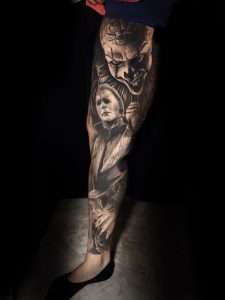 A horror tattoo should do more than show a frightening face. It should create a feeling before anyone can name the subject. If you are searching for skräck tatuering idéer realism, start with atmosphere: the empty darkness around a figure, the expression in the eyes, the texture of aged skin, smoke, stone, or decaying fabric. In black and gray realism, those details turn a familiar horror reference into something personal and lasting.
The strongest horror work is rarely a copied movie image placed on skin. It is a composition with a point of view. Maybe it reflects a fear you have overcome, a fascination with the unknown, or a character that stayed with you long after the credits rolled. The goal is not simply to make people look. It is to give them something to feel.
Start with the feeling, not the character
A recognizable character can be a great starting point, but it should not be the entire brief. Ask yourself what draws you to it. Is it psychological tension, supernatural menace, body horror, old gothic imagery, or the contrast between innocence and violence? That answer gives the design a direction.
For example, a clown portrait can become much darker when the composition focuses on a forced smile disappearing into shadow, rain streaking over makeup, and a barely visible balloon shape behind it. A masked figure can feel more cinematic when it is framed by a doorway, forest branches, or a long corridor instead of floating alone on the arm.
Realism works best when there is room for a scene to breathe. Negative space is not wasted skin. It is where tension builds. A dark background, a soft fade, or a break in the composition can make the detailed areas hit much harder.
Skräck tatuering idéer: realism with a story
The best horror realism tattoos often combine one central subject with supporting elements that explain the mood. A portrait alone may look impressive, but a portrait with deliberate surrounding imagery becomes a narrative piece.
Cinematic horror portraits
A close-up portrait is ideal when expression is the main event. Deep-set eyes, cracked makeup, wet hair, exposed teeth, or a stare lost in shadow can create intensity without overcrowding the tattoo. This approach suits an upper arm, thigh, chest panel, or the outer section of a sleeve.
The trade-off is scale. Realistic portraits need enough space for the eyes, skin texture, and subtle gradients to remain clear as the tattoo ages. Trying to force a highly detailed face into a small area usually removes the very details that make realism convincing.
Monsters emerging from darkness
Not every horror tattoo needs a fully visible creature. In fact, partial visibility is often more unsettling. A distorted face emerging from smoke, claws breaking through torn fabric, or a silhouette hidden behind dead trees lets the viewer fill in the rest.
This is a strong option for clients who want dark realism without a direct film reference. It also gives more freedom to create something that belongs only to you. The monster can borrow from your favorite visual influences while becoming its own design.
Gothic symbols with realistic texture
Religious statues, ravens, skulls, antique dolls, wilted roses, crows, candles, graveyard gates, and weathered stone can carry horror energy without relying on gore. They work especially well in black and gray because texture does much of the storytelling.
A cracked marble angel with hollow eyes, for instance, can feel both elegant and unsettling. A raven perched on an old grave marker can lead into mist, clouds, or forest shadows for a larger sleeve composition. These subjects are often easier to blend with existing tattoos than a single isolated character.
Psychological horror concepts
Psychological horror has staying power because it is built on discomfort rather than shock value. Think of a face split between calm and panic, a hand covering an eye, a childlike figure standing in an empty hallway, or a reflection that does not match the person in front of the mirror.
This direction is especially effective for custom work. Rather than recreating a scene exactly, you can build symbolism around a memory, fear, or personal transformation. The tattoo remains horror, but it also becomes yours.
Build the composition around the body
A design can look excellent on paper and still fail if it ignores body flow. A sleeve needs movement from shoulder to wrist. A backpiece needs a focal point that works with the spine and shoulder blades. A thigh piece can support a large portrait or creature with dramatic vertical depth.
For a horror sleeve, it often makes sense to place the main face or creature where the arm is widest, then connect it with smoke, branches, architecture, clouds, or textured darkness. These elements are not filler when they are planned correctly. They control contrast, create transitions, and make separate subjects feel like one world.
A chest piece can be more symmetrical and confrontational. A large central skull, mask, demon, or statue can work well there, provided the artist accounts for how the design moves across the pectoral muscles. On the back, a narrative scene has more room to unfold: a central figure, surrounding environment, and secondary details that reward a closer look.
Be honest about the scale your idea needs. If the vision includes several faces, a detailed setting, and fine texture, it is probably asking for a larger project. Starting with one strong section and expanding later can work, but only if the full composition is considered from the beginning.
Why black and gray suits horror realism
Black and gray removes the distraction of color and puts the focus on light, shadow, contrast, and texture. That makes it particularly powerful for horror. A pale face against deep black, fog rolling across a graveyard, or a single bright highlight in an eye can create a cinematic effect that color is not required to achieve.
It also allows different references to live together more naturally. A realistic animal skull, a gothic cathedral window, and a horror portrait can be tied together through consistent contrast and shading. The result can feel like one complete artwork rather than a collection of separate images.
Still, darker is not always better. If every inch is packed with solid black, fine details can disappear and the tattoo can become visually heavy over time. Good dark realism uses a full range of values, from deep blacks to soft skin-tone highlights. That contrast is where dimension lives.
Bring references, but leave room for custom design
Reference images are useful when they explain mood, lighting, facial features, or placement. Bring a few that show what you respond to, then explain why. One image may have the right expression, another the right background, and a third the texture you want in the shadows.
Avoid treating references like a shopping list. Combining too many unrelated ideas can weaken the concept. A focused direction gives the artist space to create a coherent composition instead of squeezing every favorite symbol into one area.
A good consultation should cover placement, size, existing tattoos, skin tone, how visible you want the piece to be, and whether the design is meant to grow into a sleeve or backpiece. It should also leave room for professional guidance. Some details need to be enlarged, simplified, or moved so the tattoo can read clearly for years.
Choose horror that will still mean something later
Trends can be fun, but a large realism tattoo deserves more than a quick reaction. Choose imagery you will still connect with when the initial excitement has settled. That does not mean the tattoo needs a heavy personal meaning. A lifelong love of dark cinema, gothic art, folklore, or monsters is reason enough.
What matters is that the final piece feels intentional. Let the horror reference be the spark, then build a custom composition around the mood, scale, and story you want to carry. The most memorable dark realism tattoos do not just reproduce fear. They give it a form that is entirely your own.