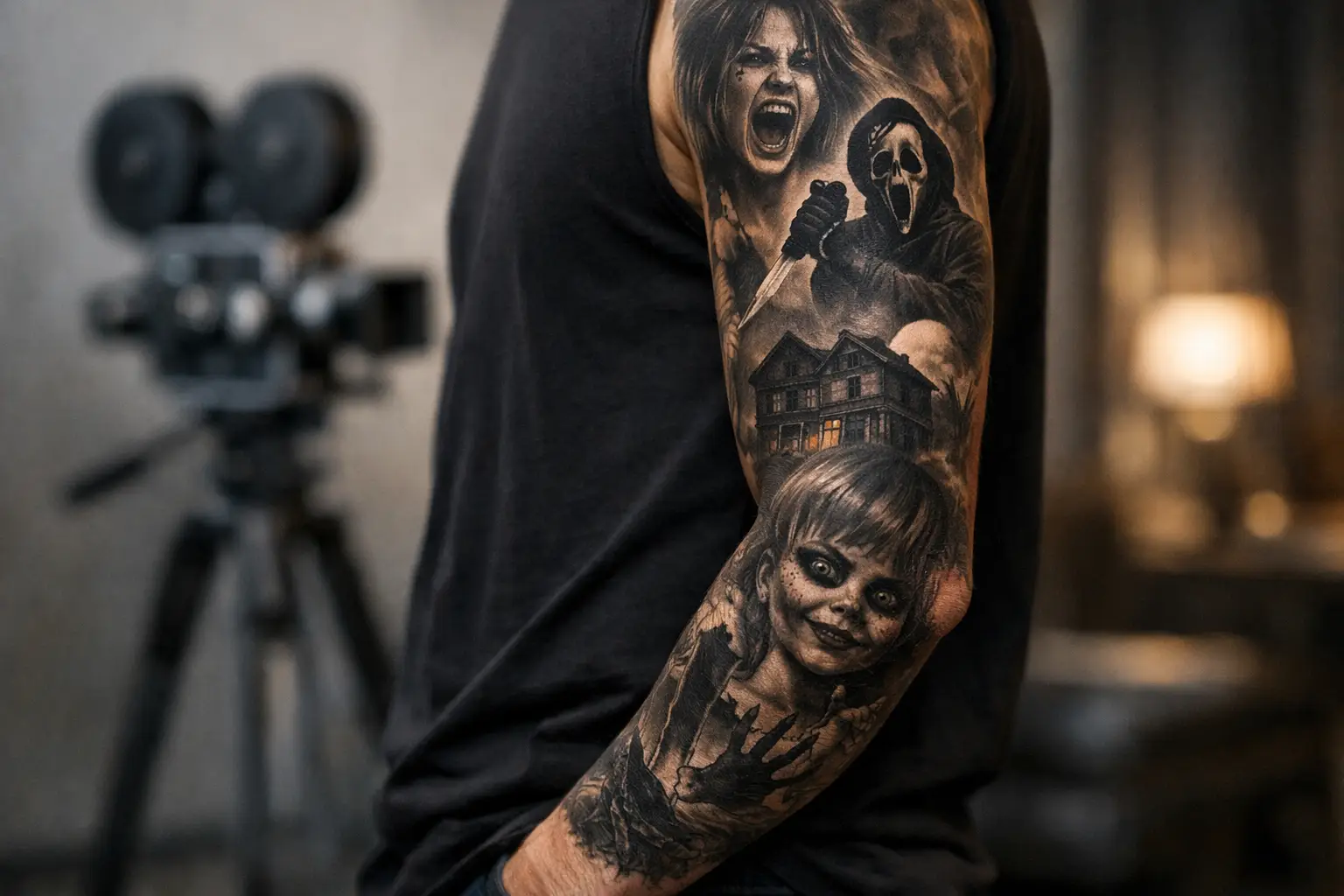
A great horror sleeve should not look like a row of posters squeezed onto an arm. It should feel like one tense scene unfolding as the body moves. The strongest cinematic horror tattoo sleeve ideas use shadow, pacing, recognizable details, and a clear focal point to turn favorite films into a personal black and gray composition.
For a large-scale realism piece, the question is rarely just, “Which character do I want?” The better question is, “What feeling do I want this sleeve to leave behind?” Dread, isolation, panic, revenge, the supernatural, or the quiet suspense before something appears in the dark can all shape the final design.
Build a cinematic horror tattoo sleeve around a story
Film works because every frame directs the eye. A sleeve needs the same discipline. The shoulder, upper arm, elbow, forearm, and wrist each offer different shapes, levels of visibility, and amounts of movement. Treating them as one connected canvas creates a result that feels intentional from every angle.
The shoulder is usually the place for the main image: a portrait, masked figure, creature, or an atmospheric establishing shot. The upper arm can carry supporting elements such as a moonlit house, trees, smoke, a hallway, or a weapon. The forearm is ideal for a second emotional beat, while the wrist can hold a smaller closing detail like a handprint, silhouette, film grain texture, or a meaningful quote kept subtle.
A sleeve does not need to retell an entire movie. In fact, trying to include every iconic moment usually weakens the composition. One central character paired with two or three carefully chosen references often has more impact than six unrelated faces competing for attention.
Start with the mood, not the movie list
A client may arrive with several films they love. That is useful inspiration, but it is not yet a design. The common thread matters more. A psychological horror sleeve and a classic slasher sleeve can both be cinematic, yet they require completely different visual language.
Psychological horror often benefits from negative space, distorted portraits, empty corridors, eyes in shadow, reflections, and restrained detail. The horror comes from what is implied. Slasher-inspired work can take a sharper approach, using masks, blades, torn fabric, harsh lighting, and a more direct sense of threat.
Supernatural horror gives more room for atmosphere. Fog, ravens, dead branches, cathedral windows, old houses, candles, and ghostly silhouettes can connect the major images without making the arm feel crowded. Creature horror often works best when the creature is allowed to dominate one section of the sleeve rather than being reduced to a small background reference.
Before drawing, consider what belongs in the foreground and what should stay barely visible. Horror is stronger when some details reward a closer look.
Cinematic horror tattoo sleeve ideas with real flow
The masked figure and the empty street
A masked character placed high on the upper arm can create a powerful first read. Instead of surrounding it with random objects, build a quiet nighttime setting around it: an empty suburban street, a single streetlight, distant houses, and deep black shadows fading toward the elbow.
On the forearm, a second image can show a hand, a weapon, or a small silhouette at the end of a hallway. This structure gives the sleeve a beginning and an aftermath. It is especially effective in black and gray because the bright mask or face can sit against a field of dark value.
The haunted house as a central setting
A decaying house is one of the most flexible foundations for a horror sleeve. It can be personal, cinematic, and visually rich without relying on a large portrait in every section. Place the house on the upper arm or outer forearm, then let bare trees, smoke, cloud cover, and broken windows guide the design around the arm.
Inside or around the architecture, smaller references can be hidden naturally: a face behind a window, a child’s toy, a raven on a branch, a shadow in a doorway, or an old television glow. This approach is ideal for someone who wants a horror theme that feels timeless rather than tied to one scene alone.
The monster reveal
Some creatures demand space. A realistic monster portrait with sharp texture, wet skin, teeth, or unnatural eyes needs enough room for the details to breathe. The upper outer arm or forearm is usually the right place, depending on which image should be most visible.
The key is contrast. A creature can be highly detailed, but if everything around it is equally dark and busy, the face disappears. Use open skin, fog, or soft gradients near the focal point, then let dense blacks build behind the head, mouth, or eyes. The result feels closer to a dramatic film still than an illustration pasted onto skin.
The cursed object and the human reaction
Not every horror sleeve needs a villain portrait. A cursed object can carry just as much tension: a videotape, antique doll, old camera, boarded-up door, phone receiver, mirror, or music box. Pair it with a realistic hand reaching toward it, recoiling from it, or holding it under a hard beam of light.
This is a strong direction for clients who want horror with more symbolism. The object can represent a particular film reference, but it can also connect to a personal story about fear, memory, obsession, or survival. That extra layer makes the sleeve feel less like merchandise and more like body art made for one person.
Black and gray folklore horror
Cinematic horror does not have to come only from modern film. Nordic forests, ravens, skulls, ritual imagery, ancient masks, wolves, and mythological figures can create a darker folklore-based sleeve with a cinematic sense of scale. A moon behind branches, a figure emerging from mist, or an animal staring directly out from the skin can establish tension without relying on blood or gore.
This direction works beautifully when realism is balanced with texture. Fur, bark, stone, weathered metal, and smoke offer natural transitions between images. It also gives the sleeve a broader visual life, especially for someone drawn to both horror and mythology.
Make the elbow and inner arm work for the design
The elbow is not a blank spot to fill at the end. It bends, heals differently, and naturally interrupts straight imagery. Dark smoke, cracked texture, tangled roots, storm clouds, webs, or an abstract burst of shadow usually work better here than a detailed face.
The inner arm deserves the same planning. It is a more intimate area, and the skin can be sensitive. A close-up eye, a whispered quote, a hanging silhouette, a candle flame, or a narrow hallway can fit the vertical space without forcing a large scene into an awkward shape.
This is where an experienced custom approach matters. A reference image can inspire the tattoo, but it cannot determine the placement by itself. The anatomy of your arm should guide the final composition.
Contrast is what keeps horror readable
Black and gray realism depends on value control. Deep blacks create the atmosphere, but highlights create the fear. The reflection in an eye, a pale face emerging from darkness, light catching a blade, or a bright window at the end of a hall gives the viewer somewhere to look.
Too much black can make a sleeve feel heavy from a distance. Too little can leave it flat and weak once it heals. The right balance depends on skin tone, the amount of existing tattoo work, the subject matter, and how dark you want the piece to feel over time.
Texture should serve the scene as well. Film grain, rain, smoke, scratches, and fog are useful tools for linking separate references, but they should never become filler. Every transition should lead the eye toward the main image or deepen the atmosphere.
Choose references without copying a poster
Bring the scenes, characters, lighting, and visual details that matter to you most. Then allow the final design to become its own composition. A direct copy of a promotional poster may look familiar, but it often ignores the shape of the arm and misses the chance to make the work personal.
A custom sleeve can combine a recognizable character with a setting from another scene, change the camera angle, remove unnecessary background elements, and add symbolism that belongs only to you. That freedom is where a tattoo becomes more than a tribute.
For clients planning a large horror project, it helps to think in sessions rather than isolated tattoos. Start with the focal point and the darkest structural areas, then build the atmosphere and secondary imagery around them. This protects the flow of the full sleeve and leaves room for the design to develop with purpose.
The best cinematic horror sleeve is not the one with the most references. It is the one that still feels unsettling, clear, and personal years later. Bring the images that stay with you, the mood you want to wear, and enough room for the design to become something uniquely yours.