A religious tattoo can carry a lifetime of belief, grief, gratitude, protection, or family history. That is why religious realistic tattoos ask for more than technical detail. They need a clear personal reason, a strong composition, and an artist who understands that the image is not simply decoration.
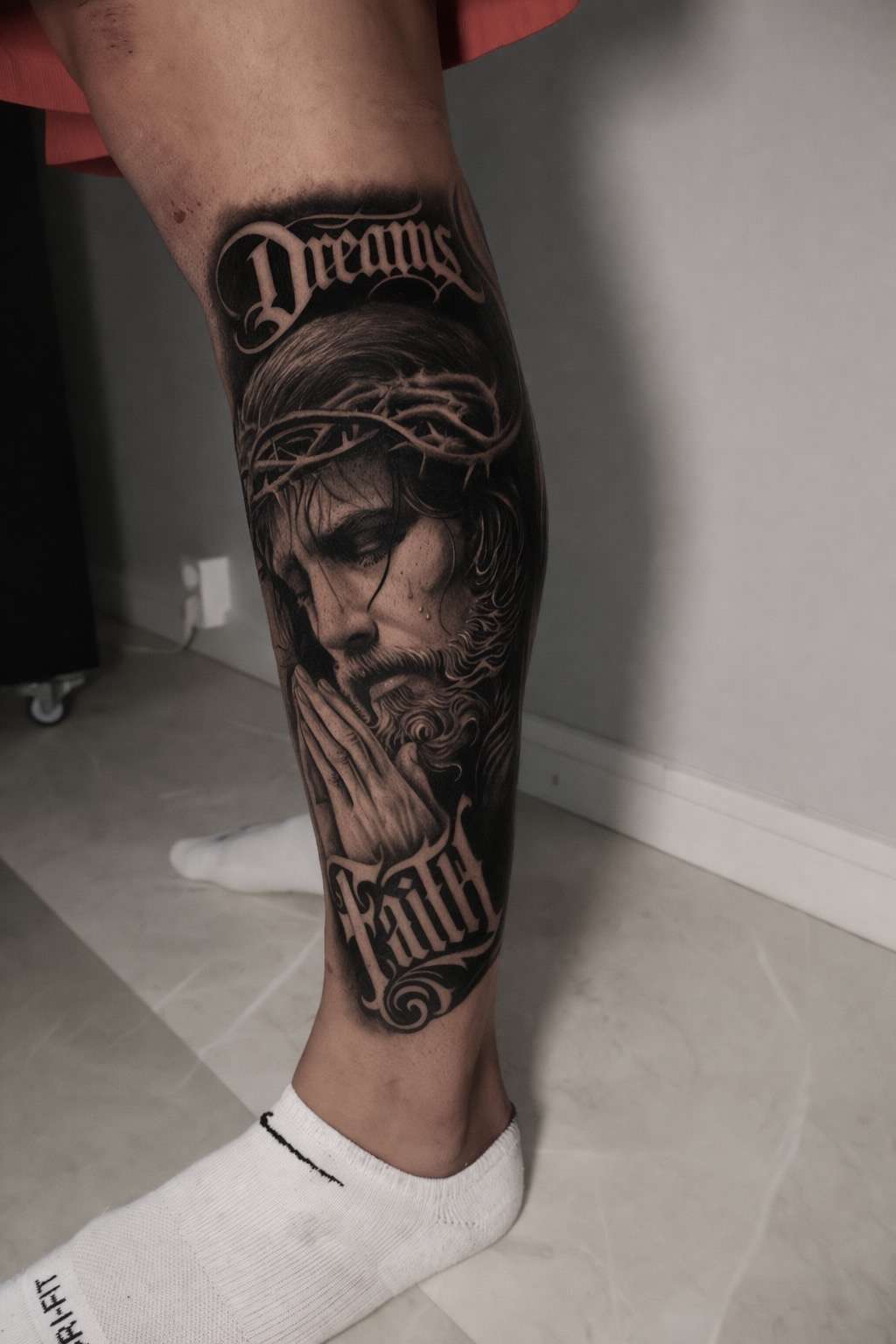
Black and gray realism is especially powerful for faith-based work because it gives familiar symbols weight. Light through clouds, the texture of aged stone, a weathered face, folded hands, or a rosary resting against skin can create a piece that feels lived-in rather than printed on. The best result is not a copy of a reference image. It is a custom composition built around what the subject means to you.
Why Realism Changes a Religious Tattoo
Religious imagery has been tattooed for generations, but realism creates a different kind of presence. A finely rendered portrait of Christ, a guardian angel, a saint, a praying mother, or a classical sculpture can feel intimate and immediate. The eye reads emotion in the face, depth in the shadows, and movement in the fabric or wings.
That realism also raises the standard. Small technical choices matter: where the brightest highlights sit, how much contrast supports a face, whether the expression feels peaceful or severe, and how the background frames the central symbol. A meaningful concept can lose impact if it is crowded with unrelated elements or rendered without enough contrast to hold over time.
For large-scale black and gray work, the goal is controlled depth. Dark areas give the tattoo structure. Soft gray transitions create atmosphere. Open skin can become light breaking through clouds, a halo, a window, or simply breathing room around the subject. That balance is what keeps a detailed tattoo readable from both close up and across a room.
Start With the Story, Not the Symbol
A cross, dove, angel, scripture, or praying hands can be a strong starting point. On its own, though, it may not say much about the person wearing it. Custom work becomes more powerful when the central religious image is connected to a real story.
Perhaps the tattoo honors a parent who found strength in faith. Maybe it marks recovery, a loss, military service, a personal promise, or a moment when life changed direction. A date, a name, a meaningful flower, a place, or a small object can add context without turning the tattoo into a collage.
For example, praying hands can be designed as a personal memorial by combining them with a subtle handwritten note, a specific rosary, or light falling from a meaningful direction. An angel can become more individual through an expression, a pose, or a background that reflects protection rather than generic religious imagery. A portrait can carry a saint-like quality without pretending to be a historical image.
The strongest concepts usually have one main subject and a supporting atmosphere. When every available space is filled with clocks, doves, clouds, roses, text, and multiple portraits, the eye has nowhere to rest. Large projects can include many layers, but each layer should serve the same story.
Questions Worth Answering Before Designing
Before a consultation, think beyond the image you have saved. What feeling should the tattoo hold: peace, sacrifice, resilience, guidance, mourning, devotion, or hope? Is the piece primarily about religious faith, a loved one, or both? Do you want a quiet image that reveals detail up close, or a high-contrast composition with immediate impact?
It also helps to decide what must be included and what is only an inspiration. A reference is useful for mood, lighting, facial expression, or placement. It should not become a demand for an exact duplicate. A tattoo deserves to fit your body, your story, and the artist’s hand.
Choosing the Right Subject and Visual Language
Religious realism is broad. Christian themes are common, but the same approach can be applied to many traditions and personal forms of spirituality. The important part is respect. Sacred imagery should be chosen because it holds genuine meaning, not because it looks dramatic in a reference photo.
Portraits of Jesus, Mary, saints, monks, or family members work best when the face is given enough space. Faces need room for smooth transitions, clear eyes, and expressions that do not disappear into surrounding shadows. The upper arm, chest, thigh, and back offer more freedom for this than smaller areas.
Architectural imagery can create an entirely different mood. Cathedrals, stained-glass effects, stone statues, graveyard crosses, and candlelight are ideal supporting elements for darker realism. They can add scale and atmosphere while letting the primary figure remain the focus.
Scripture or prayer can be included, but text is rarely the first thing to design. Long passages often become too small to age cleanly, especially when squeezed around detailed realism. A short line, a date, or a meaningful word may carry more power. The design should make the text feel integrated, not pasted over the image at the end.
Placement Is Part of the Composition
A realistic tattoo should follow the body rather than fight it. A sleeve can tell a story in chapters, with a central figure on the upper arm and supporting clouds, architecture, or symbolic objects moving toward the forearm. A chest piece can create a direct, symmetrical statement, while a backpiece gives room for a full scene with dramatic light and scale.
Placement changes how an image reads. A calm portrait on the inner forearm feels personal and close. A guardian angel across the back can feel protective and monumental. A cross on the hand may be visible every day, but the size and constant exposure make fine realism harder to preserve than it would be on the upper arm or chest.
Skin movement matters too. Areas near joints bend, stretch, and heal differently from flatter surfaces. A skilled design accounts for that before tattooing begins. Sometimes the right choice is to simplify one section or move a face a few inches to protect the details that matter most.
Size Is Not Just a Matter of Boldness
Realism needs enough room to breathe. Tiny details may look sharp in a fresh photograph, but skin is not paper. Over time, tightly packed lines and soft gray areas can merge if there is not enough separation in the design.
This does not mean every religious tattoo needs to become a full sleeve or backpiece. It means the design should be honest about what the chosen size can hold. A small cross with dramatic light can be striking. A detailed scene with several faces, architecture, and readable text needs more space if it is meant to remain clear for years.
Building a Tattoo That Ages With Integrity
Timeless tattoos are built on contrast, composition, and restraint. In black and gray realism, that means using deep blacks where the structure needs to last, preserving clean skin breaks for highlights, and avoiding too much pale gray in areas that need visual strength.
Reference photos can be deceptive. A tattoo may look very soft and subtle when it is fresh, yet need stronger dark values to remain readable after healing and natural aging. This is where artistic guidance matters. The goal is not to make every shadow as dark as possible. It is to create enough hierarchy that the subject stays clear.
Aftercare is part of protecting the work. Follow the artist’s healing instructions, avoid picking or over-moisturizing, and keep healed tattoos protected from sun exposure. Good care will not replace a strong design, but it helps preserve the contrast and detail that made you choose realism in the first place.
A Personal Process for a Personal Image
A custom religious tattoo should begin with conversation. Share the story, the references, the placement you are considering, and any elements that are non-negotiable. Be open to feedback on scale, contrast, and composition. The best collaboration is not about saying yes to every idea. It is about protecting the final piece from choices that weaken it.
At Dimitris Steiger, the focus is on translating personal ideas into black and gray realism with a clear visual direction. Whether the concept is a single devotional image or the foundation of a larger sleeve, the design should feel intentional from the first line to the final detail.
Bring the reason behind the image, not just a folder of references. A religious tattoo becomes more lasting when it carries your faith, your memory, and your own point of view in every part of the composition.