A strong black and grey tattoo does not need loud contrast tricks or trend-driven details to hold attention. It earns that attention through depth, balance, texture, and the kind of composition that still feels right years later. If you are searching for a black and grey tattoo Gothenburg artist, the real question is not just who can tattoo well. It is who can take your idea, your references, and your story and turn them into a piece that belongs on your body.
Black and grey realism is one of the most demanding styles in tattooing because there is nowhere to hide. Without bright color, everything depends on drawing, value control, smooth shading, and how the design moves with the body. When it is done right, it feels timeless. When it is rushed, copied, or forced into the wrong placement, the flaws show fast.
What makes a great black and grey tattoo in Gothenburg
The first thing to look for is not just technical skill in a close-up photo. It is consistency across different projects, different body parts, and different scales. A single healed detail shot can look impressive. A full sleeve, chest panel, or backpiece tells you far more about an artist’s real ability.
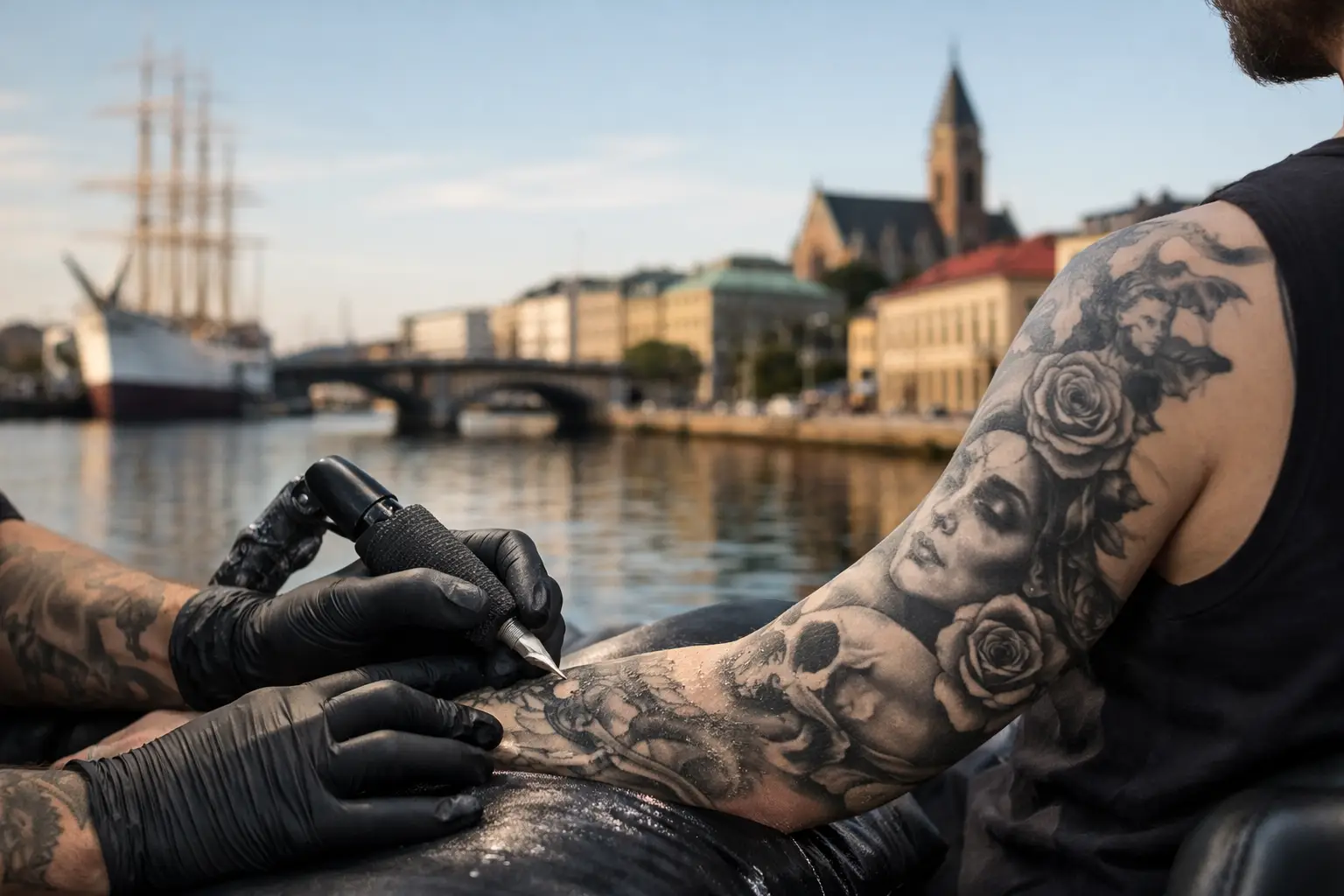
Good black and grey work has structure. Dark areas create weight, lighter transitions create atmosphere, and the mid-tones do a lot of the heavy lifting. In realism, skin breaks matter just as much as ink. They give the eye room to rest and help details stay readable over time. That is especially important in larger work built around animals, mythological figures, horror references, or layered narrative scenes.
The second thing is design judgment. Not every reference image should become a tattoo exactly as it is. A strong artist knows when to simplify, when to push contrast, and when to leave something out. Tattooing is not photo printing. Skin changes the rules.
Why custom black and grey work matters
The difference between generic and custom work is easy to feel, even when people cannot immediately explain it. Generic work often looks assembled. Custom work feels composed.
If you want a wolf, a raven, a Viking portrait, a skull, a forest scene, or something darker and more cinematic, the point is not to collect symbols for the sake of looking tough or dramatic. The point is to build a piece with meaning and flow. Maybe the tattoo is tied to family history, a period of loss, a personal transformation, or simply imagery that has stayed with you for years. That is where custom design matters.
In black and grey realism, storytelling can happen quietly. It can be in the expression of a face, the weather in the background, the way a serpent wraps through a sleeve, or how an animal and a landscape are fused into one composition. A personal tattoo does not have to explain itself to everyone. It just has to feel honest to you.
That is why the design process should be collaborative. The artist brings composition, technical knowledge, and visual discipline. You bring the core idea, references, and intent. The best results come when both sides take the process seriously.
Black and grey realism is not one single look
People often use one label for very different aesthetics. Black and grey realism can lean soft and atmospheric, dark and heavy, clean and sculptural, or gritty and textured. The right direction depends on the subject matter and the placement.
A portrait piece usually needs a different treatment than a horror sleeve. Viking-inspired work often benefits from weight, mood, and strong contrast, while nature-based realism may need more air and subtle transitions to keep it from becoming visually crowded. Animal tattoos can go either way. A bear, raven, or owl can feel mythic and dark, or calm and almost photographic.
This is where style match matters. If you are choosing an artist for black and grey tattoo work in Gothenburg, look beyond whether they have tattooed the same subject before. Pay attention to whether their overall visual language matches what you want. The question is not just, can they tattoo a wolf? It is, can they tattoo your wolf in a way that fits the rest of your vision?
Placement changes everything
A design that works on paper can fail on skin if placement is treated as an afterthought. Large-scale black and grey work needs room to breathe. A sleeve has to wrap naturally. A backpiece needs hierarchy so the eye knows where to land first. A forearm piece has to read from more than one angle.
This matters even more with realism because detail can disappear if it is pushed into a space that is too small or too curved. Sometimes clients come in with an idea that would be stronger as a half sleeve instead of a single isolated piece. Sometimes a concept needs to be simplified to age better. Sometimes the right answer is to wait and plan a larger composition rather than filling a space too quickly.
There is no universal rule here. More detail is not always better. Bigger is not always better either. The best placement is the one that gives the design enough room to speak clearly and still work with your anatomy.
What to expect from the custom process
A serious black and grey project usually starts with a conversation, not a stencil pulled from a wall. You should be ready to share the subject matter, placement, approximate size, and the feeling you want the piece to carry. Reference images help, but they are a starting point, not a blueprint.
A good consultation often includes some pushback, and that is a good thing. If an idea needs editing to work better as a tattoo, you want to hear that early. Maybe two separate concepts should not be forced into one area. Maybe the mood is right but the composition is not. Maybe the design needs stronger negative space so it does not close up visually over time.
For larger projects, thinking long term matters. A sleeve or backpiece should not feel like separate stickers competing for space. It should feel intentional from edge to edge. That level of cohesion takes planning, patience, and trust in the process.
How to judge an artist’s portfolio
Look for healed work when possible, not only fresh tattoos under perfect lighting. Fresh black and grey tattoos can look extra dramatic before the skin settles. Healed work tells you more about smoothness, readability, and how well the contrasts hold.
Also pay attention to variety within specialization. An artist can be clearly focused on black and grey realism while still showing range in subject matter and composition. That is a strong sign. It shows artistic control, not repetition.
Most of all, ask yourself whether the portfolio feels personal or formulaic. Do the pieces look like the same layout repeated with different faces and animals dropped in? Or does each project seem built around the client’s story, anatomy, and theme? If you want something unique, that difference matters.
Is black and grey right for your idea?
Usually, yes, if you are drawn to mood, depth, and a more timeless look. Black and grey is especially strong for realism, mythology, religious themes, wildlife, dark symbolism, and narrative work. It also tends to suit larger compositions because the values can be layered without the visual noise that color sometimes creates.
That said, it depends on what you want the tattoo to do. If your concept relies on a very specific emotional effect, black and grey may be the better choice than color. If your idea depends on bold graphic impact from a distance, another approach may make more sense. A good artist will not force every concept into the same formula.
For first-time clients, black and grey can also feel less intimidating visually while still allowing for serious depth and detail. For experienced collectors, it offers endless room for refinement, expansion, and storytelling across larger areas of the body.
Choosing the right black and grey tattoo Gothenburg artist
The right fit is not only about talent. It is about whether the artist understands your taste, communicates clearly, and treats the work as something worth building properly. If you are planning a large-scale realism piece, you want someone who cares about flow, atmosphere, and longevity as much as the immediate impact.
In Gothenburg, that matters because people are not just looking for a tattoo to fill space. They are looking for something personal, something technically strong, and something that still feels like their own years from now. Whether your idea leans toward dark realism, wildlife, mythology, or a more layered narrative composition, the best result comes from choosing an artist whose work already speaks the language you want on your skin.
A good tattoo can look impressive for a moment. A great one keeps revealing itself every time you see it.