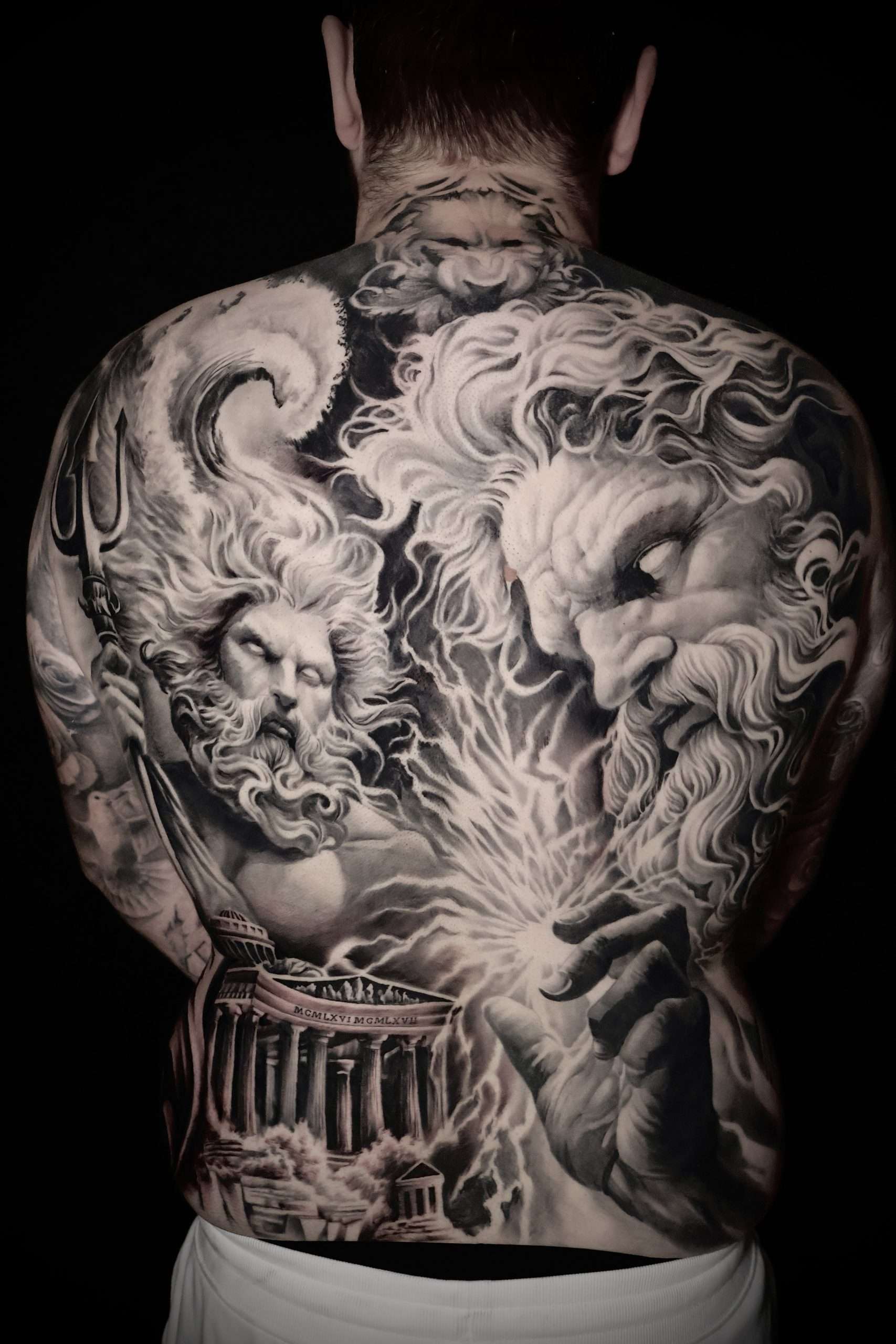
A Zeus portrait spread across the upper arm hits differently than a small myth reference tucked behind the ankle. With ancient Greek gods as realism tattoos, scale, mood, and detail change everything. These designs can look powerful, timeless, and deeply personal, but only when the concept goes beyond copying a statue and starts telling your story.
Mythology works so well in black and grey realism because it already carries weight. The faces, the symbols, the drama, the tension between beauty and destruction – it all translates naturally into tattoos with contrast, texture, and depth. But not every god fits every person, and not every reference makes a strong tattoo once it moves from stone or canvas onto skin.
Why ancient Greek gods as realism tattoos work so well
Greek mythology gives you more than recognizable figures. It gives you archetypes. Zeus is not just a bearded god with lightning. Athena is not just a helmet and owl. These are symbols of power, wisdom, war, strategy, chaos, desire, grief, and control. That is why the subject has lasting value when it is handled with care.
In realism, facial expression matters. A calm Apollo can feel completely different from a severe Apollo with deep shadow through the eyes. The same god can be interpreted in a classical, noble way or in something darker and more raw. That flexibility is part of the appeal.
There is also a strong visual advantage. Greek gods are often tied to sculptural references, which suit black and grey realism beautifully. Marble textures, broken stone, cracked surfaces, flowing hair, drapery, smoke, clouds, armor, and symbolic objects all give the artist material to build a tattoo that feels layered instead of flat.
Choosing the right god for your story
This is where the design becomes personal instead of decorative. The best mythology tattoos are not chosen just because the reference looks cool. They work because the subject reflects something real about the person wearing it.
Zeus
Zeus usually attracts people who want authority, command, or raw force in the design. He works well in large-format tattoos because his visual language is dramatic – storm clouds, lightning, intense expression, and heavy contrast. If the goal is presence, Zeus delivers. The trade-off is that he can easily become generic if the piece relies only on the usual statue portrait with a thunderbolt.
Athena
Athena suits a different kind of strength. Her symbolism is more controlled, more strategic, and often more personal. She can represent wisdom, resilience, discipline, and protection. In realism, Athena gives you great compositional tools: helmet detail, shadowed eyes, owl imagery, spears, olive branches, and architectural elements. She is often one of the strongest choices for clients who want power without chaos.
Hades
For darker black and grey work, Hades has serious potential. He can carry themes of death, depth, control, secrecy, and inner strength. This is not always about being grim for the sake of it. Hades can be quiet and imposing rather than theatrical. Smoke, darkness, the underworld, Cerberus, cracked stone, or fading faces can all create a mood-heavy design that feels built for realism.
Poseidon
Poseidon works best when movement matters. Water, waves, foam, tridents, and storm energy can turn a static portrait into something more alive. He is a strong option for sleeves and half sleeves because the surrounding elements can flow with the body. The challenge is balance. Too many effects can crowd the face, and realism always needs a clear focal point.
Apollo, Ares, Artemis, and others
Apollo can lean toward light, beauty, music, youth, and precision. Ares is blunt force, conflict, aggression, and battlefield energy. Artemis brings a more independent and primal feel, often tied to animals, hunting, and the moon. Each one has a different emotional tone. That tone should match both your personality and the place on the body where the piece will live.
Realism tattoos need more than a statue reference
One of the biggest mistakes with mythology tattoos is choosing a famous bust or museum image and treating that as the whole design. A strong tattoo needs more than a single copied reference. Skin is not marble, and tattoos are not framed images. They need composition, flow, contrast, and breathing room.
A realism tattoo based on Greek mythology should be built with intention. That might mean combining a portrait with symbolic elements, adjusting the expression to create more emotional impact, or placing supporting details in a way that makes sense for the anatomy. A shoulder cap can hold a commanding god face. A forearm may need a narrower composition with stronger vertical movement. A full sleeve can tell a myth rather than simply present a character.
This is where custom work matters. The design should respond to your body and your story, not just to a reference image found online.
Best placements for ancient Greek gods realism tattoos
Large mythology concepts usually need room. Faces, fine textures, and atmospheric details do not age well when they are compressed too tightly.
The upper arm, forearm, chest, thigh, and back are often the strongest placements for this subject. A chest piece can make a god feel monumental, especially when paired with clouds, architecture, or symmetrical framing. A sleeve allows more storytelling and movement. A thigh piece can hold a large portrait with less distortion over time. The back offers the most freedom if you want a full narrative scene.
Smaller placements are possible, but there is a compromise. If the tattoo becomes too small, the face loses subtlety, and the symbolism has to be simplified. That does not make it a bad idea, but it changes the kind of realism you can achieve.
Black and grey is usually the right choice
Ancient mythology almost always feels strongest in black and grey realism. The reason is simple: this subject depends on atmosphere. Shadow, contrast, and texture create the sculptural effect that makes these pieces feel timeless.
Color can work in some cases, especially if the concept leans heavily into dramatic skies, fire, or painterly references. But for most clients drawn to gods, statues, ruin, smoke, and classical imagery, black and grey gives the piece more gravity. It also keeps the focus on form and emotion rather than decoration.
For an artist focused on black and grey realism, mythology opens up a lot of creative depth. The design can feel ancient and sharp at the same time, especially when the details are controlled instead of overloaded.
Making the tattoo feel original
Greek gods are famous subjects, so originality matters. That does not mean inventing a new deity. It means finding a visual angle that belongs to you.
Maybe Athena is combined with imagery tied to your personal discipline or profession. Maybe Poseidon is not about the sea in a generic sense, but about surviving chaos. Maybe Hades reflects loss, transformation, or a private side of your identity that does not need to be explained to anyone else. Originality often comes from intention, not from trying to be shocking.
A good custom design also avoids the trap of stuffing in every symbol connected to the god. More is not always better. Sometimes one face, one object, and the right atmosphere create a stronger tattoo than a crowded collage of references.
What to think about before committing
This kind of tattoo rewards patience. If you are considering ancient Greek gods as realism tattoos, think first about the emotional tone you want. Do you want calm authority, violence, grief, protection, mystery, or transformation? Then think about whether you want a single portrait, a larger story scene, or a full concept that can grow into a sleeve or backpiece later.
It is also worth being honest about size. Realism needs room. If you love subtle expression, cracked stone texture, and layered black and grey depth, give the design space to breathe. A rushed version usually loses the very things that made you want it in the first place.
For clients who are drawn to bold custom black and grey work, mythology can become something far more personal than a classical reference. In the right hands, it turns into a piece that carries strength, symbolism, and presence every time you look at it. If the idea stays with you, that is usually a sign it is worth building properly.