A realism tattoo only works when it holds up after the first impression. The striking portrait, animal, or Viking figure needs more than accurate shading on the day it is finished. It needs a strong composition, deliberate contrast, and a connection to the person wearing it. That is what separates Sweden custom realism tattoos from a copied image placed on skin.
For collectors looking for black and gray realism, the goal is rarely just to make something look realistic. The goal is to create a piece that feels personal at first glance and continues to reveal detail over years of living with it. Whether the subject is a raven, a childhood memory, a cinematic horror reference, or a Norse-inspired scene, the strongest work begins with a story and a clear idea of how it will live on the body.
What Makes Custom Realism Different
Custom work is not about choosing from a wall of ready-made designs. It starts with a conversation about subject matter, meaning, placement, and atmosphere. Reference images are useful, but they are a starting point, not a final answer. A photograph may have the right expression. A movie still may carry the right mood. An old illustration may suggest texture or symbolism. The design comes alive when those elements are reworked into one composition built specifically for you.
Realism is especially dependent on this process because skin is not paper. A design that looks good as a flat image may lose impact if the focal point sits in the wrong place, if details are too small, or if the flow fights the movement of the arm, chest, or back. Custom planning lets the artwork follow the anatomy instead of being forced onto it.
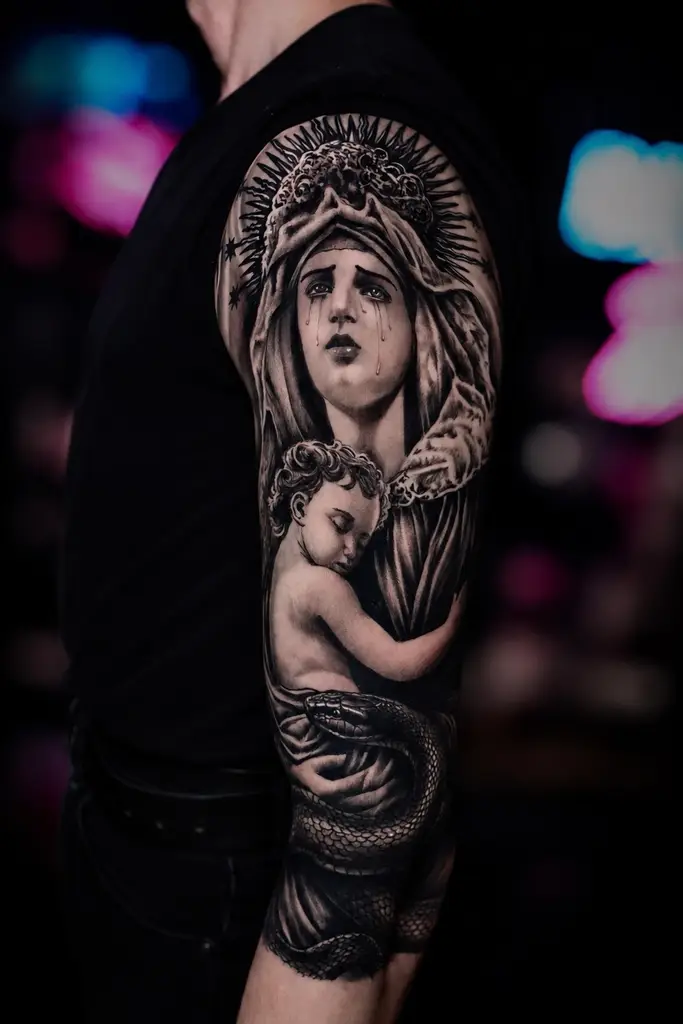
For a large piece, this matters even more. A sleeve is not a collection of isolated images. It is a visual journey from shoulder to wrist. A backpiece needs space for the eye to move, moments of quiet contrast, and a main subject that carries the composition. The same is true of a leg project or chest panel. Scale gives realism room to breathe, but only when every element has a reason to be there.
Sweden Custom Realism Tattoos Need Strong Composition
Detail gets attention, but composition makes detail readable. In black and gray realism, that often means balancing deep blacks, smooth midtones, and open skin. Without this balance, a tattoo can become visually heavy or lose clarity as the eye moves across it.
A wolf portrait, for example, may be technically precise, but it needs a focal point. Usually that is the eyes, the direction of the head, or the contrast around the face. Background elements such as forest, smoke, runes, clouds, or stone should support that focal point rather than compete with it. The same principle applies to horror work. A recognizable character or unsettling expression has more power when it emerges from controlled darkness instead of being buried in it.
Black and gray also creates a timeless visual language. It can feel dramatic without relying on color, and it allows texture to do much of the storytelling. Fur, weathered skin, metal, armor, feathers, cracked stone, and mist all respond differently to light. Those material changes give a realism tattoo depth and make the design feel alive from different distances.
Bigger Is Not Always Better, but Space Helps
Large-scale tattoos are ideal for highly detailed realism because they allow room for smooth transitions and meaningful secondary elements. A backpiece can hold a complete narrative. A sleeve can connect an animal, landscape, symbol, and portrait into one direction. But a large tattoo should never be large simply for the sake of filling space.
Sometimes a focused forearm piece is the better choice. A single animal head, a meaningful object, or a dark portrait can have serious impact when the design is edited with care. The trade-off is that smaller pieces need stronger simplification. Fine details may need to be removed or enlarged so they remain visible and age well. Good realism is not measured by how much can be packed in. It is measured by how clearly the idea reads.
Bring the Story, Not a Finished Blueprint
Clients often worry that they need to arrive with a fully formed concept. You do not. A useful starting point can be as simple as, “I want something about resilience,” “I have always connected with ravens,” or “I want a Nordic-inspired piece that feels dark rather than decorative.” From there, the design process can find the right subject, mood, and composition.
The most helpful references show what you are drawn to, even when they are unrelated. One image may show the lighting you like. Another may show the animal’s expression. Another may suggest a landscape or texture. Sharing those details makes it easier to understand your direction while leaving room for an original result.
It also helps to be honest about placement and lifestyle. A highly visible hand or neck tattoo has different considerations than a piece on the upper arm or thigh. Areas that bend, receive more sun, or experience regular friction may call for different levels of detail. Pain tolerance, available session time, and whether you want to build toward a full sleeve all influence the right plan. There is no one answer for everyone, and that is why a consultation matters.
The Design Should Move With the Body
A tattoo is experienced in motion. Your arm turns. Your shoulder flexes. Your posture changes. The design needs to look intentional from more than one angle, especially when the work wraps around a limb.
For sleeves, the outer forearm and upper arm often provide strong areas for faces, animals, or major symbolic elements because they can be seen clearly. Inner-arm space can support shadows, transitions, or more private details. On the back, the spine and shoulder blades can guide symmetry or create tension around an asymmetrical scene. These decisions are not rules, but they are useful tools for making a piece feel integrated rather than pasted on.
Dimitris Steiger approaches custom black and gray realism with that full-body perspective in mind. The artwork is designed as a personal composition, not as a generic image resized to fit an available space.
Healing Is Part of the Final Result
Fresh tattoos are only one stage of the work. Once the initial shine and redness settle, healed contrast and line quality become the real test. Following aftercare instructions, keeping the area clean, avoiding picking, and protecting the tattoo from sun exposure all affect how the finished piece settles into the skin.
Skin type, placement, and daily routine can influence healing. A tattoo on a high-movement area may need extra care. Very dry skin can make healed work appear dull until it is properly moisturized. Sun exposure is one of the biggest threats to long-term contrast, particularly in black and gray pieces where subtle tone changes do so much of the visual work.
Plan your sessions with healing in mind as well. Large projects are built over time, and spacing sessions properly gives the skin a chance to recover while allowing the overall composition to develop with intention. Patience is part of getting a result that lasts.
Choose Meaning Over a Momentary Trend
Trends can be a useful source of inspiration, but they should not make the final decision for you. The tattoos people connect with most deeply usually carry something beyond the image itself. A bear can represent protection. A skull can speak to mortality, survival, or transformation. A Viking figure can reflect heritage, strength, or a personal relationship with mythology. The meaning does not need to be explained to everyone else. It only needs to feel true to you.
Bring the images, memories, symbols, and dark ideas that stay with you. The best custom realism tattoos are built from those details, then shaped with enough space, contrast, and craftsmanship to make the story worth wearing for life.