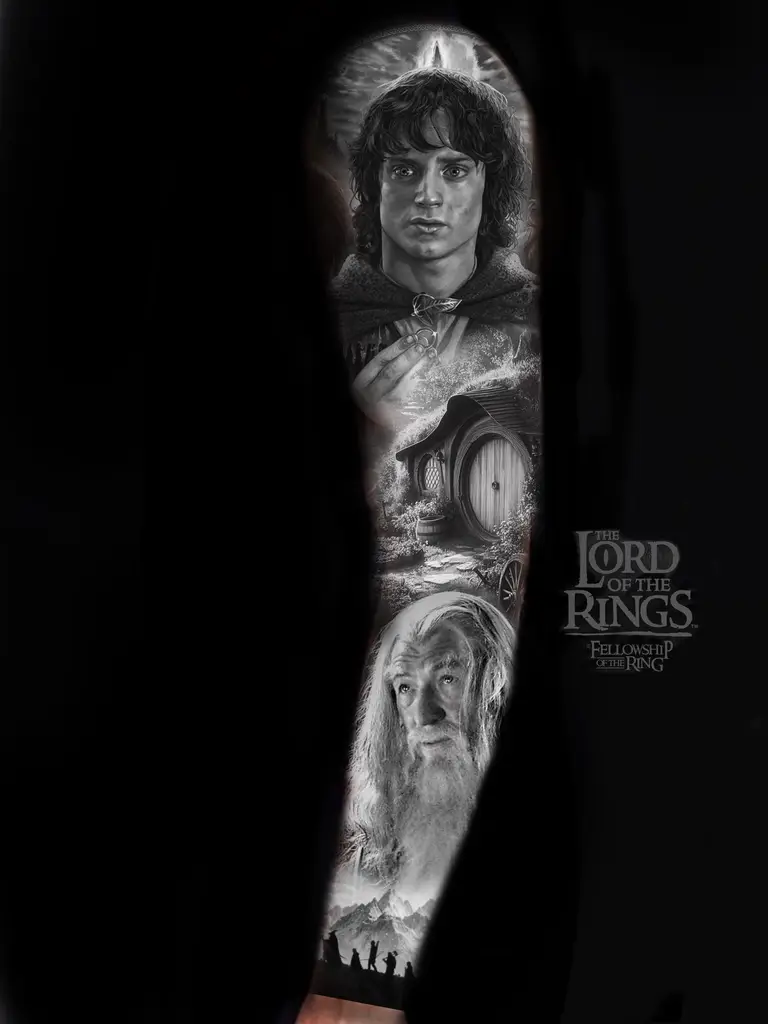
A weathered map of Middle-earth wrapping around an arm. The Eye of Sauron emerging from a field of smoke. A quiet image of the Shire hidden inside a larger forest sleeve. The strongest lord of the rings tattoos are not simply references that other fans recognize. They carry a memory, a personal battle, a place that feels like home, or a line from the story that stayed with you long after the screen went dark.
For a tattoo with this much visual history, the goal should be more than fitting a familiar symbol onto skin. The goal is to create a piece that feels like it belongs to you, holds up over time, and has enough depth to reward a second look.
Why Lord of the Rings Tattoos Work So Well
Few fantasy worlds offer as much visual material as Tolkien’s Middle-earth. There are ancient landscapes, powerful objects, recognizable architecture, creatures, armor, script, and themes that go far beyond fantasy. Fellowship, grief, courage, temptation, loyalty, and the decision to keep moving when the road gets dark all give the imagery real emotional weight.
That range makes these tattoos especially suited to custom work. One person may connect most strongly with the Fellowship. Another may want the raw darkness of Mordor, the Nazgûl, or a battle-worn warrior. Someone else may want something almost private: a small leaf of Lórien, a White Tree silhouette, or a single word in Elvish-inspired lettering.
The design becomes stronger when you begin with the reason behind the reference. Instead of saying, “I want a Lord of the Rings tattoo,” ask what part of the story is yours. Is it resilience? Family? Adventure? A love of the darker side of the world? That answer gives the composition direction before any image is chosen.
Choosing Symbols With Personal Meaning
A good tattoo concept usually has one main subject and supporting elements that build atmosphere. Trying to include every favorite character, location, weapon, and quote in one piece can leave the design crowded. A sleeve or backpiece can hold a larger narrative, but even then, each element needs room to breathe.
For black and gray realism, portraits and cinematic scenes can create a dramatic focal point. Aragorn, Gandalf, Gollum, the Witch-king, or a ringwraith can work beautifully when the tattoo has enough skin area to show expression, texture, and contrast. A portrait should feel intentional, though. It needs to be about more than choosing a recognizable face from a film still.
Landscape-driven ideas offer a different kind of power. The Argonath, Minas Tirith, Rivendell, the Shire, or Mount Doom can form the base of a larger composition. Nature is especially useful here. Trees, mountains, mist, ravens, roots, and storm clouds can connect scenes naturally across the arm, chest, or back without making the tattoo look like separate images placed next to one another.
Symbols often work best when they are used with restraint. The One Ring, the White Tree of Gondor, the Evenstar, the Doors of Durin, the Prancing Pony, or the broken sword Narsil can carry a lot of meaning without requiring a full cinematic scene. They are also easier to make personal by combining them with details from your own life, whether that is a landscape, an animal, a date, or a subtle memorial element.
Text requires extra care. Tengwar-style script has a beautiful visual rhythm, but accuracy matters. Confirm the wording, spelling, and intended translation before it becomes part of the stencil. Small script can also lose clarity as it ages, so the placement, letter size, and amount of detail need to be considered honestly.
Let the Main Image Lead
If your central idea is the Eye of Sauron, let it dominate the composition and use smoke, ruined towers, lava, or the One Ring as supporting details. If the main subject is a journey, a map texture or winding path can guide the eye through the entire tattoo. The strongest designs have a clear visual hierarchy: first you see the story, then you find the details.
Scale and Placement Change Everything
Lord of the Rings tattoos can work as small symbols, but the most detailed concepts benefit from space. Fine architecture, realistic faces, armor, and atmospheric backgrounds need enough room for contrast and clean structure. A detailed Minas Tirith scene on a very small area may look impressive on day one, yet become difficult to read after years of natural settling in the skin.
An outer forearm can suit a focused symbol, portrait, or vertical scene. The upper arm gives more space for a character with a background. A full sleeve is ideal for a journey-based design that moves from dark to light, such as Mordor fading into mountain forests or the Shire. For truly expansive scenes, the back, chest, or thigh gives the artist room to create depth without compressing the image.
Placement should also match how visible you want the tattoo to be. A hand or neck placement may feel bold, but those areas are not always the best choice for highly detailed realism. A larger, more stable area of the body usually gives the artwork a better chance to age with clarity.
Building Lord of the Rings Tattoos in Black and Gray
Black and gray realism is a natural fit for Middle-earth because it can create atmosphere without relying on bright color. Deep blacks can give Mordor, the Eye, or a ringwraith real weight. Soft gray wash can create fog around mountain ranges, old stonework, and distant forests. Skin breaks can become light through clouds, moonlight, or the shine of a blade.
The trade-off is that black and gray work depends heavily on contrast. If every area is mid-gray, the tattoo can become flat. If every shadow is pushed too dark, smaller details may disappear. The composition needs clear dark areas, open skin, and soft transitions. This is where experienced planning matters more than adding extra elements.
Texture also makes a difference. A cloak should not read like stone. Ancient armor should not read like smoke. Tree bark, chain mail, ruined masonry, and weathered parchment each need their own approach. Those subtle contrasts are what make a fantasy tattoo feel tactile and alive rather than copied from a poster.
From Reference Images to a Custom Composition
Reference images are useful, but they should start a conversation, not end one. Bring the scenes, characters, symbols, and mood you are drawn to. Then be open to changing the layout so the tattoo follows your body properly. An image that works in a rectangular movie frame may need to be rebuilt completely for an arm or shoulder.
During a custom design process, the key decisions are usually the story, main focal point, placement, scale, and overall mood. You may know that you want Gandalf, for example, but the real design question is whether he should appear as a calm portrait, a battle scene, a figure moving through a storm, or part of a larger journey. Each choice tells a different story.
At Dimitris Steiger, the focus is on turning those references into a unique black and gray composition rather than repeating generic flash. That may mean simplifying an idea, expanding it into a larger project, or finding a more personal symbol that says the same thing with greater impact.
Give the design time at this stage. A large tattoo is not improved by rushing to include one more reference. It is improved by making every chosen detail earn its place.
Think Beyond the First Session
A lasting tattoo needs more than a strong concept. It needs a practical plan for the skin. Fine details should be sized for longevity. Strong black areas should be balanced against lighter space. The design should work with the curves and movement of the body rather than fighting them.
Healing and aftercare matter too, especially with larger black and gray pieces completed over multiple sessions. Follow your artist’s guidance, avoid picking or over-moisturizing, and protect healed work from long periods of direct sun. A well-designed tattoo is built to age well, but sun exposure and poor care can still soften contrast over time.
The best time to commit is when the idea feels personal enough to outlast the moment. You do not need to explain every symbol to everyone who sees it. You only need to know why that road through Middle-earth belongs on your skin.