Surrealism works best when it feels personal, not decorative. In tattooing, that matters even more because the image has to hold up on skin, not just on a screen. Black and gray is especially powerful here. Without the distraction of color, the eye goes straight to contrast, composition, texture, and mood. If the concept is strong, black and gray gives it gravity.
What makes a surreal black and gray tattoo work
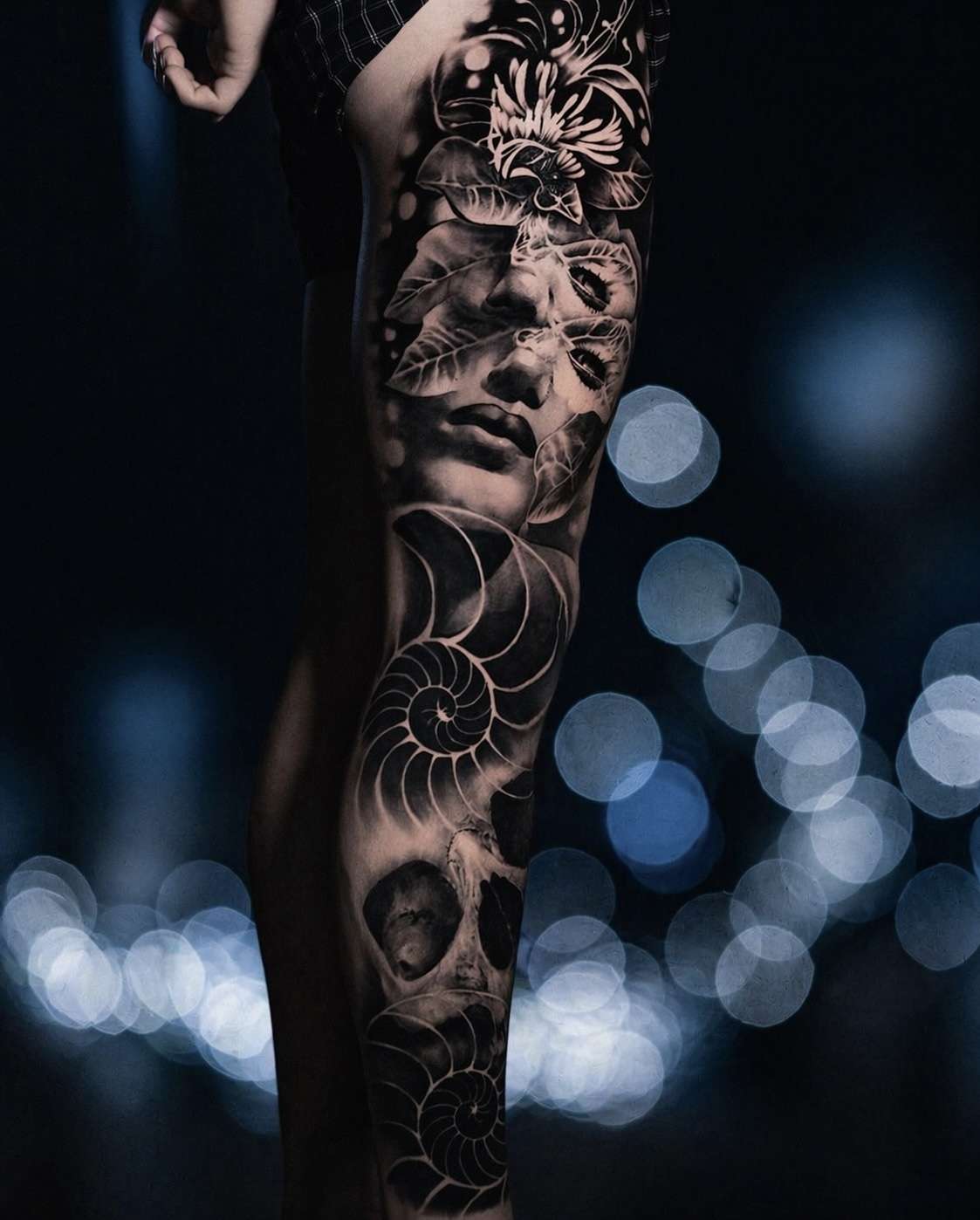
Surreal tattoos often borrow from realism, but they should not stop at realism. A realistic eye, an animal skull, a forest, a clock, a statue, a raven, a face split by shadow – these are not surreal on their own. The surreal part comes from the way they interact. A wolf emerging from smoke where a human portrait should be. A Viking figure dissolving into branches and crows. A serene face interrupted by mechanical fragments, antlers, or impossible space.
The goal is not to be strange for the sake of being strange. The goal is to create a visual language that feels emotionally true, even if it is impossible in real life. That is why the best surreal tattoos usually have a clear anchor. Maybe it is grief, memory, fear, transformation, ancestry, obsession, or protection. Once that anchor is clear, the imagery has direction.
In black and gray, that direction becomes even more important. The piece needs enough contrast to read from a distance, enough detail to reward a closer look, and enough open skin to breathe. If every part is packed with the same value and texture, the design can turn muddy over time. Surreal work should feel layered, but not crowded.
Surreal black and gray tattoo Göteborg ideas that feel original
A lot of people come in with references they like, but what they usually want is not a copy of that image. They want the feeling behind it. That is where the custom process matters.
If you are drawn to darker surrealism, your idea might start with horror-inspired imagery, distorted faces, religious symbols, ravens, candles, broken masks, or skeletal forms. If your taste leans more mythic, the starting point might be Norse themes, ancient statues, wolves, forests, storm textures, runic elements, or battle-worn figures. Some clients want something deeply narrative. Others want a piece that stays more open and symbolic.
Both approaches can work. It depends on how you want the tattoo to speak. A literal story can be powerful, especially in a sleeve or backpiece where there is room to build scenes. A more abstract surreal composition can feel stronger if you want people to sense the meaning without reading it all at once.
This is also where restraint matters. Not every meaningful symbol needs to be included. Sometimes two or three strong elements create more impact than ten smaller ideas fighting for space. If the concept is about transformation, for example, you may not need every symbol connected to change. One face, one animal form, and one environmental texture may say more than a packed collage ever could.
Why black and gray suits surreal realism so well
Black and gray has a timeless quality that fits surreal imagery better than many people expect. It creates depth without forcing the piece into a loud or graphic look. For clients who want something cinematic, dark, and refined, this palette gives a lot of control.
The technical side matters too. Smooth shading helps transitions feel dreamlike. Deep blacks create structure. Soft mid-tones let smoke, skin, stone, fur, and shadow blend naturally into each other. That is especially useful in surreal tattoos because the image often shifts from one state to another. A face becomes a skull. A forest becomes hair. Clouds become wings. In black and gray, those transitions can happen in a way that feels natural instead of forced.
There is a trade-off, though. Black and gray relies heavily on contrast and composition, so weak design choices show up fast. You cannot hide an unclear focal point behind bright color. You cannot rely on color separation to save a confusing layout. The structure has to be solid from the start.
Placement changes the whole piece
A surreal tattoo lives or dies by flow. The same concept can feel average on one part of the body and powerful on another.
Sleeves work well for layered storytelling because the arm naturally breaks the image into chapters. You can place a dominant focal point on the outer forearm or upper arm, then let surrounding imagery wrap and connect around it. This suits surreal realism because it gives room for transitions. Smoke, branches, hair, feathers, cracks, and shadow can guide the eye instead of ending abruptly.
Backpieces are ideal for large concepts with multiple focal areas. If you want scale, atmosphere, and a more immersive scene, the back gives you space to build it properly. Chest and torso placements can be striking too, especially for symmetrical or emotionally heavy work, but the design has to respect movement and anatomy.
Smaller placements can still work, but they need discipline. Surreal tattoos depend on visual relationships, and that gets harder when the space is limited. A compact idea is possible, but it should be built around one clear concept rather than several competing ones.
The design process should feel collaborative
A good custom tattoo process is not about handing over a rough idea and hoping for the best. It is about shaping your references, themes, and story into something that belongs on your body.
That often starts with a conversation around mood rather than exact images. What draws you in? What should the tattoo feel like when someone sees it up close? Do you want it to feel ominous, calm, raw, mythic, unsettling, protective, mournful? Those answers give much more useful direction than a folder full of disconnected screenshots.
References still matter, but they work best as clues. Maybe one image has the right lighting, another has the kind of texture you love, and another captures the right emotional weight. From there, the design can be built into something original.
For large surreal black and gray work, patience is part of the process. Complex designs need time to develop properly, especially if they include portrait elements, animals, or narrative transitions. That is not a delay. That is where the quality comes from.
At Unikum Tattoo in Gothenburg, this kind of work makes the most sense when the client comes in ready to build something personal rather than pick something generic off the wall. The result is stronger because the design is built around meaning, anatomy, and long-term wear.
What to think about before booking
If you are considering a surreal black and gray tattoo Göteborg artists may offer many styles, but not every artist approaches surreal realism the same way. Look closely at healed work, not just fresh photos. Pay attention to whether the tattoos have clear focal points, readable contrast, and smooth transitions. Technical detail matters, but so does composition.
You should also be honest about scale. If your idea depends on subtle realism, layered symbolism, and complex transitions, it may need more room than you first expected. Trying to force a large concept into a small area usually means losing the very details that made it compelling.
And think long term. The best surreal tattoos are not trend pieces. They are personal images built with enough clarity and craftsmanship to age with character. That means choosing imagery you still want to carry when the novelty is gone.
A surreal black and gray tattoo can be dark, beautiful, unsettling, mythic, or deeply intimate. The strongest ones usually sit somewhere between those qualities. If your idea has real meaning behind it, and the design is given the space and attention it needs, the final piece does more than look impressive. It starts to feel like it was always supposed to be there.