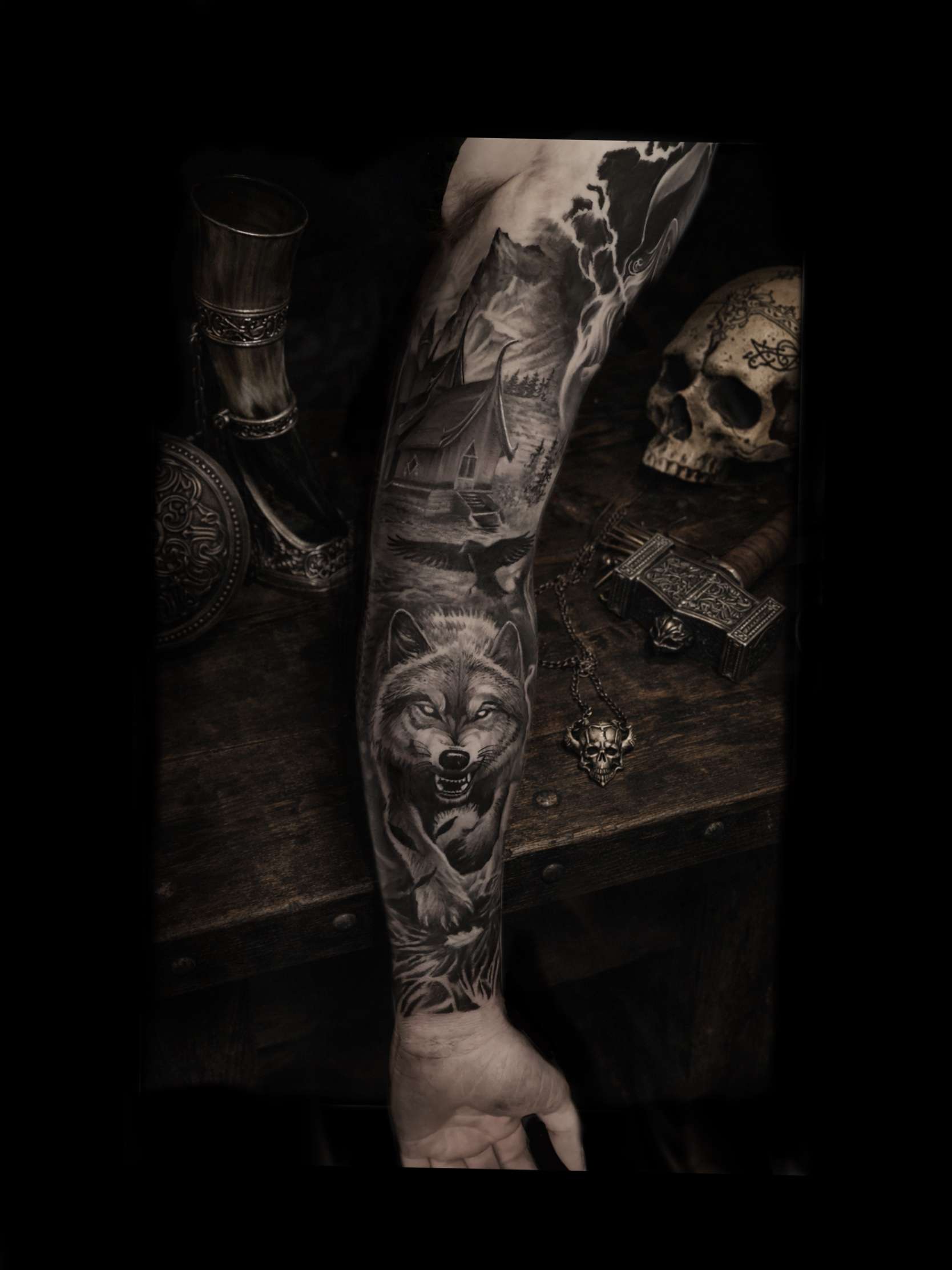
Viking-inspired work has a lot of visual power on its own. The problem is that many designs stop at familiar symbols – a helmet, a raven, a compass, a stern face with a beard. Those elements can look great, but large-scale realism needs more than recognizable references. A sleeve or backpiece has to hold together as one composition. It should read clearly from a distance, then reward a closer look with texture, atmosphere, and detail.
What makes realistic Viking tattoos work on a large scale
Realism and Viking imagery are a natural match, but only when the piece is designed as a full composition. A portrait of Odin, a battle-worn warrior, a ship cutting through fog, wolves, ravens, forests, storm clouds, runic textures, and Nordic ornament can all belong in the same project. The key is restraint. If every idea gets pushed into one tattoo, the result becomes crowded fast.
The best large-scale work usually has one dominant subject and a supporting environment around it. That dominant subject might be a realistic face, a warrior torso, or a major scene across the back. The supporting elements create rhythm and atmosphere. Smoke, cracked stone, weather, fur, wood grain, metal, and dark background transitions help connect everything without making the tattoo feel busy.
Black and grey realism is particularly strong for this style because it gives weight to age, mood, and texture. Viking themes often carry a sense of myth, hardship, ritual, and nature. Black and grey translates that in a way that feels timeless. Color can work too, but for sleeves and backpieces with darker storytelling, black and grey often ages with more cohesion and keeps the mood consistent.
Realistic Viking tattoos sleeve and backpiece planning
A sleeve and a backpiece need different thinking, even if the theme is the same. The arm is constantly moving and viewed in sections. The back is more like a full canvas. That changes how the story should be built.
How a Viking sleeve should flow
A sleeve is rarely seen all at once. People catch the outer arm first, then the inner arm, then the lower forearm or upper arm as the body turns. That means the composition needs anchor points in the right places.
For realistic Viking tattoos on a sleeve, a strong outer-arm focal point often works best. This might be Odin, a warrior portrait, or a raven with high contrast. The forearm can carry secondary imagery such as a ship, axe, runes worked into stone, or a wolf head. The inner arm usually benefits from softer transitions, darker atmosphere, or more protected details because that area can heal differently and tends to be more sensitive.
The biggest mistake in Viking sleeves is treating each section like a separate tattoo. A realistic sleeve should feel connected. Hair can turn into smoke. Smoke can become storm clouds. Clouds can transition into carved wood, rocky mountains, or a sail in the wind. When those shifts are done well, the tattoo feels alive on the body.
How a Viking backpiece should be built
A backpiece gives much more freedom, but it also demands more discipline. There is room for a major narrative scene, yet scale can expose weak planning immediately.
A realistic Viking backpiece usually needs a clear central structure. That might be a frontal figure, a seated god, a ship scene across the shoulders, or a battle composition framed by ravens or wolves. The spine often acts like a visual axis. The shoulder blades, lower back, and ribs create natural rises and dips, so the design has to respect the body rather than fight it.
Backpieces are perfect for atmosphere. Fog, forests, storm skies, mountain forms, and distant structures can create depth without stealing attention from the main subject. This matters because realism is not just about rendering. It is about creating space. A good backpiece breathes. It has contrast, open skin where needed, and visual rest between heavier details.
Choosing the right Viking imagery
Not every Viking symbol belongs in a realistic composition. Some motifs are naturally stronger in realism, while others work better as graphic or ornamental elements.
Portrait-based imagery usually carries the most emotional weight. Odin, a nameless warrior, or a weathered face inspired by Norse mythology can become the heart of the tattoo. Those faces create expression, tension, and presence. They also allow for detailed textures like skin, scars, braided hair, fur, and metalwork.
Animals are often what give the tattoo movement. Ravens bring direction and shape. Wolves bring aggression and focus. Bears can add mass and raw force. Serpents can be effective too, especially if the composition needs something to wrap, divide, or guide the eye through the body.
Ships are useful because they suggest journey, conflict, and fate without being too literal. In a sleeve, a longship can help create horizontal movement around the arm. In a backpiece, it can sit across the upper back or emerge from storm and mist as part of a wider scene.
Runes and knotwork need a careful hand. Used lightly, they can strengthen the identity of the piece. Used too heavily, they can make realism feel decorative in the wrong way. It depends on the design. If the main goal is a dark, realistic composition, those details usually work best when integrated into armor, stone, wood, or background texture instead of floating separately on the skin.
Why custom design matters more with Viking tattoos
Viking work is popular, which means it is easy for it to become generic. The visual language is strong, but that also makes repetition obvious. If the tattoo is meant to mean something personal, it needs more than familiar imagery arranged in a standard way.
This is where custom design changes everything. Maybe the idea is not just Viking mythology, but endurance, ancestry, protection, grief, discipline, or a connection to wilderness. Those themes can shape the final composition. A raven might represent memory. A storm might stand in for chaos survived. A warrior does not have to be a historical character. He can become a symbolic figure built around your own story.
That approach creates a tattoo with staying power. It looks powerful immediately, but it also keeps its meaning years later. That matters with large-scale work because sleeves and backpieces are not casual choices. They become part of how you carry yourself.
Building a piece that will still look strong years from now
Timeless tattoos usually come from strong contrast and smart composition, not from packing in the maximum amount of detail. Realism needs detail, of course, but detail without hierarchy disappears over time.
For Viking sleeves and backpieces, that means choosing where the eye should land first. The main face, animal, or scene needs clean readability. Background elements should support depth, not compete with it. Dark passages need lighter breaks. Highly textured zones need smoother transitions nearby. That balance is what keeps the tattoo powerful on healed skin, not just on day one.
It also helps to avoid chasing a trend version of Viking imagery. The strongest work feels grounded, personal, and intentional. It can be cinematic, dark, mythic, or brutal, but it should still feel built for your body and your story.
If you are thinking about realistic Viking tattoos, sleeve and backpiece projects deserve more than a folder full of reference images. Start with the feeling you want the tattoo to carry, then build the imagery around that. When the concept, anatomy, and craftsmanship all line up, the result does not just look impressive – it feels like it belongs there.