
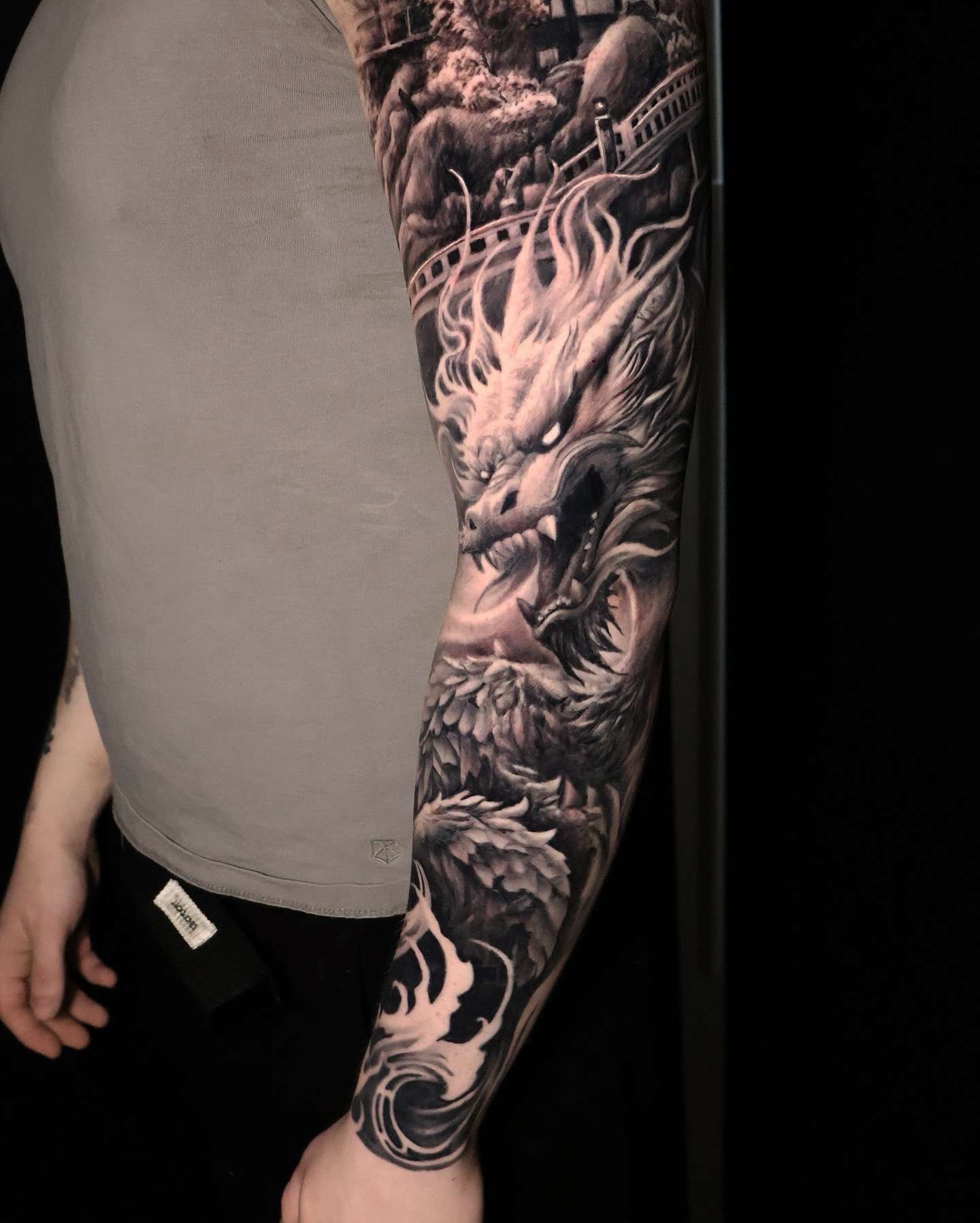
What makes realistic japanese tattoos different
Traditional Japanese tattooing has its own rules. Composition matters as much as the main subject. Background is never an afterthought. Wind bars, waves, smoke, flowers, and negative space all guide the eye and give the tattoo rhythm.
Realism works differently. It relies on texture, anatomy, lighting, contrast, and believable form. When you combine the two, the goal is not to copy a painting or make a museum-style reproduction. The goal is to preserve the strength and symbolism of Japanese imagery while giving it more dimension, emotion, and presence on the skin.
That balance is what separates strong realistic japanese tattoos from designs that feel confused. If the realism is pushed too far without respecting Japanese composition, the tattoo can lose flow. If the design stays too rigidly traditional without using realistic depth well, it can feel flat. The best work sits in the middle.
Why this style works so well in black and grey
Japanese tattoo themes are often associated with bold color, and for good reason. But black and grey realism gives these motifs a very different character. It can make the piece feel more dramatic, more cinematic, and in many cases more timeless.
A black and grey dragon can carry a heavier presence through shadow and scale detail alone. A geisha portrait framed by smoke and chrysanthemums can feel quieter, darker, and more intimate than a brightly colored version. Waves, clouds, and fabric folds also gain a lot from smooth shading because they create movement without overwhelming the focal point.
This approach is especially strong for larger projects. Sleeves, half sleeves, chest panels, and backpieces give enough room for realistic depth without sacrificing the readability that Japanese-inspired work needs. Smaller tattoos can still work, but detail has limits. If the concept relies on facial expression, armor texture, layered background, and multiple symbolic elements, size matters.
Choosing the right subject for realistic japanese tattoos
Some motifs translate naturally into realism. Dragons, koi, tigers, snakes, samurai, geishas, oni masks, and Hannya all have strong shapes and emotional range. They can be powerful on their own, but they become more interesting when they connect to the wearer’s story.
That part matters. A tattoo with Japanese imagery should not feel like decorative wallpaper placed on the body. It should have a reason behind it, even if that reason is personal and not meant to be explained to everyone.
A koi can represent endurance, discipline, or a hard-earned transformation. A dragon can stand for power, protection, or controlled aggression. A samurai can symbolize loyalty, sacrifice, or self-mastery. An oni can take on darker meanings – inner conflict, fear, rage, or the face of something you had to survive. The same image can say different things depending on the person wearing it and the way it is designed.
That is why reference collecting is only the beginning. Good custom work starts when the artist looks at the feeling behind the image, not just the image itself.
Is this style right for first-time clients?
It can be, especially if you are planning a meaningful larger piece and want something that feels serious from the start. But it helps to understand what you are committing to. Realistic japanese tattoos often work best at a scale that gives the design room to breathe. That usually means longer sessions, more patience, and a clear plan.
For first-time clients, the biggest benefit of this style is that it can hold both symbolism and impact. You are not choosing between visual strength and personal meaning. You can have both.
The main trade-off is that custom large-scale work takes thought. If you want something fast, tiny, or trend-driven, this is probably not the right direction. If you want a tattoo that feels built for your body and your story, it makes sense to take your time with it.
If you are looking for black and grey realism with a custom, story-driven approach, you can see the kind of large-scale work Dimitris Steiger creates at https://www.dimitrissteiger.se/.
The right tattoo should not feel borrowed. With realistic japanese tattoos, the most powerful pieces are the ones that respect the tradition, use realism with purpose, and still feel like they could only belong to one person.